
Asphalt Base Preparation: Why Subgrade Stability, DGB20 Compaction & Drainage Matter Most
By National Road Surfacing · Updated 1 November 2026
Introduction
There is an old saying among experienced road engineers: “The asphalt wearing course gets all the credit, but the roadbase does all the work.”
When a newly laid asphalt driveway, car park, or industrial yard develops sunken wheel tracks or crocodile cracking within two years, the customer naturally blames “bad asphalt.” In reality, 90% of premature flexible pavement failures have nothing to do with the quality of the hot mix coming out of the asphalt plant—they are caused by shortcuts taken in subgrade preparation, DGB20 roadbase compaction, drainage grading, or layer bonding before the paver ever arrived on site (Accurate Stabilising).
Here is how National Road Surfacing engineers foundations for engineered asphalt paving across Sydney’s diverse geological conditions.
1. Understanding Sydney Subgrade Soils & California Bearing Ratio (CBR)
The natural earth left after excavating topsoil is called the subgrade. In civil engineering, subgrade strength is measured by its California Bearing Ratio (CBR %)—the higher the CBR percentage, the stronger the soil:
- Coastal Sands & Hawkesbury Sandstone (Eastern Suburbs, Northern Beaches, Parts of North Shore & Sutherland): Typically exhibit high, free-draining CBR values (
8% to 15%+), requiring moderate granular base thicknesses. - Cumberland Plain Reactive Clays & Bringelly/Ashfield Shales (Western Sydney, Inner West, Canterbury-Bankstown, Liverpool, Macarthur): Often exhibit low soaked CBR values (
2% to 4%). When dry, Sydney clay feels rock-hard; when saturated by groundwater or leaky stormwater pipes, it loses bearing capacity and turns plastic.
Why Proof-Rolling Is Non-Negotiable
Before spreading roadbase, we proof-roll the trimmed subgrade with a loaded heavy truck or roller. If a pocket of clay pumps or deflects like a sponge under the wheels, covering it with 100mm of gravel will not fix it. Soft pockets must be excavated (“bridged”) and replaced with compacted select rock, geofabric separation membrane (geotextile), or lime/cement stabilisation.
2. Choosing and Compacting the Right Roadbase (DGB20)
Above the prepared subgrade sits the unbound granular base course—the structural layer that absorbs and spreads wheel loads downward.
- What Is
DGB20?: In NSW civil specifications (TfNSW / council specs),DGB20stands for 20mm Densely Graded Base. It is a precisely crushed blend of 20mm hard quarry rock, smaller interlocking stones, and controlled stone dust fines with specified plasticity limits. - Why Optimum Moisture Content (OMC) Matters: If
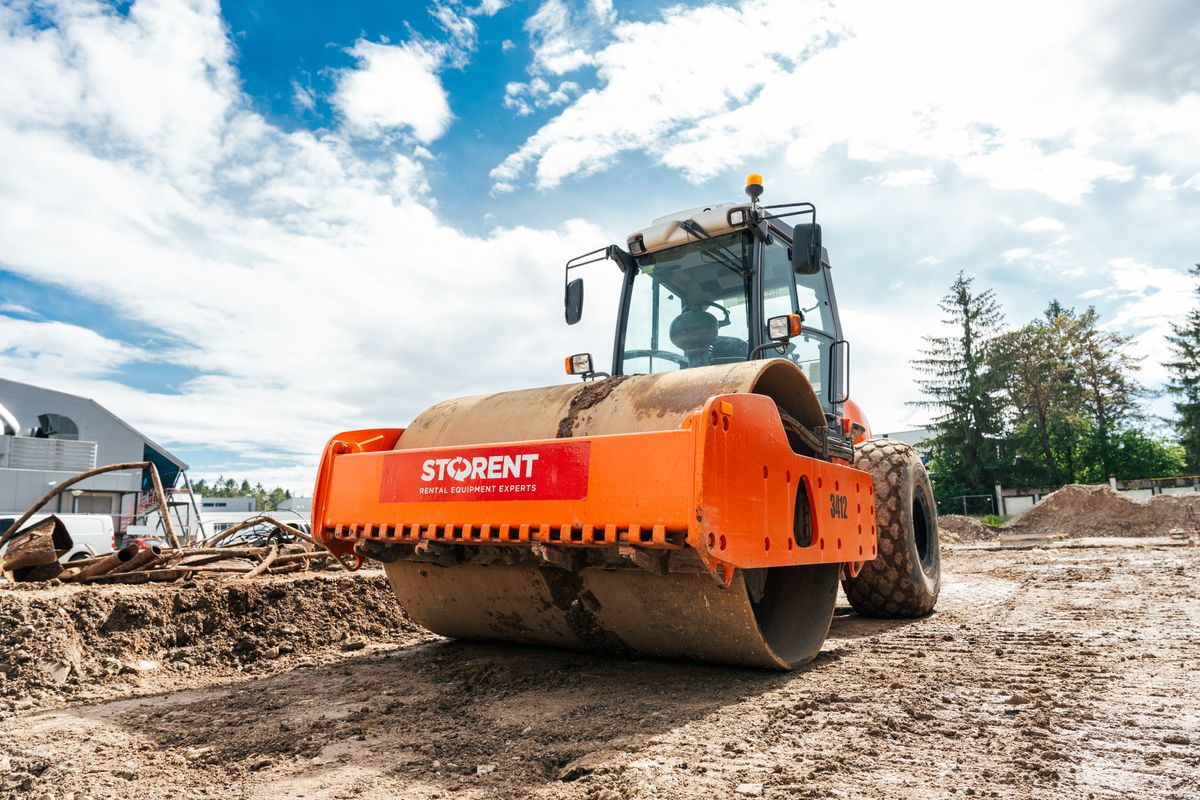
DGB20is rolled bone-dry, friction between the dry stones prevents them from sliding into a tight interlock, leaving air voids that collapse the first time rain hits. If rolled soaking wet, water trapped between the pores prevents compaction (“slurry wave”). Roadbase must be moisture-conditioned to its Optimum Moisture Content (~6%–8%), spread in lifts no thicker than 100mm–150mm compacted, and vibrated with heavy rollers until it rings solid like concrete under a hammer.
3. Surface & Subsoil Drainage: Keeping the Base Dry
Even the best compacted DGB20 loses strength if it sits below the water table:
- Surface Cross-Falls (
2%–3%): Both the finished asphalt surface and the trimmed subgrade beneath the roadbase should slope at a minimum1:50(2%) to1:33(3%) grade toward gutters or grated pits. - Subsoil Drainage (
Ag-Lines): Along cut embankments, retaining walls, or low kerb lines where groundwater seeps horizontally under the road, slotted subsoil agricultural pipes wrapped in geotextile filter sock and clean 20mm drainage aggregate intercept water before it can wet the roadbase.
4. The Critical Interface: Prime Coats vs Tack Coats
As highlighted by Accurate Stabilising, the thin boundary between the roadbase and the asphalt wearing course is where shear forces peak under vehicle braking:
| Treatment | Where It Is Applied | How It Works |
|---|---|---|
| Prime Coat / Primerbinder | Sprayed onto a freshly trimmed, swept unbound granular roadbase (DGB20) before laying asphalt or a spray seal. |
Low-viscosity cutback bitumen or special emulsion that soaks 5mm–10mm deep into the pores of the roadbase, toughening the top crust, waterproofing the base during construction, and bonding to the asphalt above. |
| Tack Coat | Sprayed onto an existing asphalt layer, milled surface, concrete slab, or between two hot mix asphalt lifts (AC20 -> AC14). |
Sticky cationic bitumen emulsion (CRS/CAM) that breaks from brown to shiny black as water evaporates, gluing the old and new asphalt layers into a single structural beam. |
Recommended Roadbase & Asphalt Thickness Guide by Application
| Site Application | Typical Subgrade Condition | Minimum Compacted DGB20 Roadbase |
Minimum Compacted Asphalt Thickness |
|---|---|---|---|
| Pedestrian Footpath / Cycleway | Firm trimmed soil | 100 mm |
25 mm – 30 mm AC7 |
| Residential Car Driveway | Firm clay/shale (CBR >= 4%) |
100 mm – 150 mm |
30 mm – 40 mm AC10 |
| Strata Driveway / Commercial Car Park Bays | Proof-rolled subgrade | 150 mm – 200 mm |
40 mm – 45 mm AC10 |
| Commercial Car Park Aisles / Light Trucks | Proof-rolled subgrade | 200 mm |
45 mm – 50 mm AC14 |
| Heavy-Duty Industrial Hardstand | Proof-rolled / stabilised subgrade | 200 mm – 300 mm+ |
75 mm–120 mm AC20 + 50 mm AC14/SMA |
Frequently Asked Questions
Can recycled crushed concrete (RCC / DGB20 Recycled) be used as roadbase under asphalt?
Yes—quality-assured NSW EPA specification recycled roadbase (blended crushed concrete and brick free of contaminants) compacts extremely well and slightly self-cements over time due to residual calcium hydroxide in the crushed concrete. However, for high-specification council roads or wet conditions, quarry-crushed virgin DGB20 basalt/granite or cement-stabilised base is often specified by civil engineers.
Conclusion & Next Steps
Never accept a cheap asphalt quote that cuts corners on excavation depth, DGB20 roadbase thickness, or tack coating. To see what happens when base preparation fails, read our next diagnostic guide: Common Asphalt Pavement Problems: Causes & Repairs.
Want your pavement engineered properly from the ground up? Call National Road Surfacing on 0475 013 264 or request a full-depth surfacing quote online.
Related Services Mentioned in This Guide
Need a Pavement Engineered from the Base Up?
Or call 0475 013 264Related Guides
The Asphalt Road Construction Process: Step-by-Step from Subgrade to Compaction
Commercial Car Parks & Industrial HardstandsIndustrial Asphalt Hardstand Design: Specifying Pavements for Heavy Trucks & Forklifts
Pavement Maintenance, Defects & RepairsCommon Asphalt Pavement Problems: Identifying Crocodile Cracking, Rutting, Raveling & Depressions